Musical Theater Audition Monologues: Why Contrast Wins, and How to Build It Into Every Line
Let's talk about the part of the musical theater audition that most performers spend the least time preparing and that ends up making the biggest difference: the monologue.
Most singers preparing for MT auditions pour the bulk of their work into the song. They pick a sixteen-bar cut, drill it, polish it, agonize over the belt or the high note, and then — almost as an afterthought — pull a monologue from a book the night before and rehearse it in the mirror a few times. It shows. The casting team can tell within twenty seconds which performers have actually trained their monologue work and which ones have memorized words.
I'm going to walk you through what I teach performers about monologue prep, and the through-line is going to surprise you. It's not about being more authentic. It's not about finding the emotional truth. It's not about your acting teacher's seven steps to a perfect read. It's about one thing.
Contrast.
Specifically, deliberate contrast in three dimensions — pitch, pace, and projection — combined with deliberate contrast between primary and secondary emotions across the monologue. If you build those two layers of contrast into a piece, you will be doing something that most of the people you're auditioning against are not doing, and the casting team will lean forward without quite knowing why.
Want to work with me one-on-one?
The Three P's of Vocal Variety
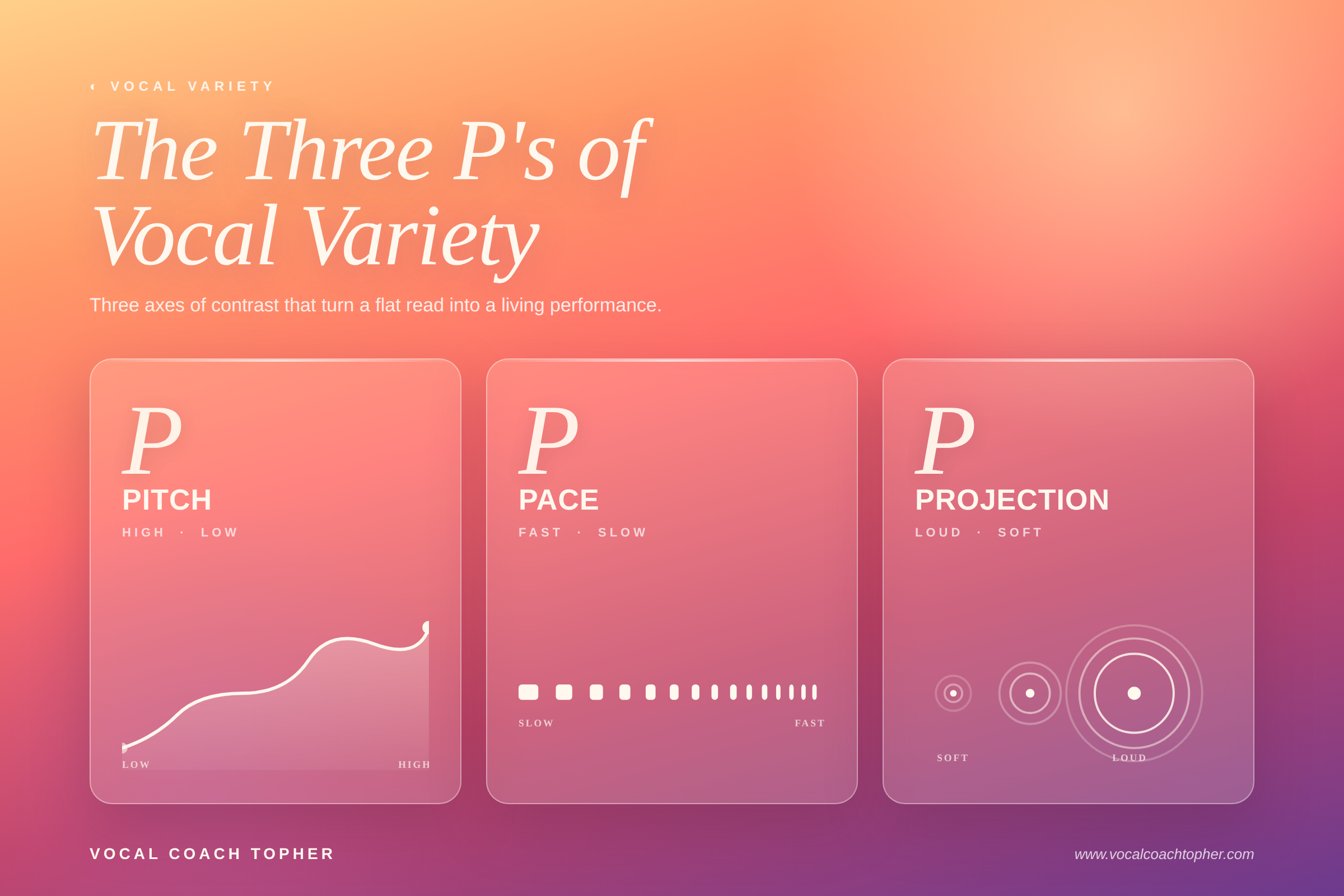
Every monologue, like every sermon, every keynote, every great piece of acting work, is built on what I call the three P's: Pitch, Pace, and Projection.
Pitch is how high or low your voice is sitting in your range. Most performers, under audition adrenaline, live in a single narrow band of pitch. They're nervous, their throat is a little tight, and they deliver every line from roughly the same note. The audition becomes one long color.
Pace is how fast or slow you're delivering the words. Same problem. Adrenaline pushes your pace up. You think you're varied — you can hear the differences in your head — but the recording says you've been racing through the entire monologue at the same speed.
Projection is how loud or soft you are. Most performers default to projection levels appropriate to the back of the house, which means a steady forte from the first word to the last. They're afraid of being too quiet. So they yell pleasantly for ninety seconds.
The trap with all three of these is that they're being flattened by your nerves, and unless you've deliberately built contrast into each one, you'll deliver the entire piece in one register, one tempo, and one volume. The casting team will hear a competent, energetic, completely unmemorable read.
Here's the discipline. Every monologue has multiple beats. Every beat is an opportunity for contrast.
When the character is threatening someone, go low in pitch, slow in pace, and pull the volume down into a near-whisper. Then when the character lashes out, spike the pitch up, quicken the pace, and let the volume jump. When the character is pleading, take the voice higher, make it thinner, slow the pace, drop the volume. When the character is proudly proclaiming, the pitch sits in the middle, the pace is measured, the projection is full.
Make those choices bigger than feels comfortable. Your sense of "too much" is calibrated to a conversational interaction with another person three feet away. The casting team is across the room. Adrenaline is going to shrink everything you do by about twenty percent. If you don't deliberately overshoot in your prep, the version that comes out in the audition will be too small.
The Sunset Analogy: Primary and Secondary Emotions
Vocal variety is the technical scaffolding. Underneath it is something more important: emotional variety.
Here is the analogy I use with every actor I coach. Imagine you're painting a sunset. You could pick a single shade of orange and fill the entire canvas with it. The result would not be a sunset. It would be an orange rectangle. A real sunset has gradients — orange and pink and purple and red and gold and the deep blue creeping in at the edges. The interplay between those colors is what makes it a sunset rather than a swatch.
Most actors approach a monologue the way an amateur paints a sunset. They pick one emotion — usually the one most obviously cued by the text — and they fill the entire piece with that single color.
Angry monologue? They deliver every line angry.
Sad monologue? They deliver every line sad.
Comedic monologue? They deliver every line at the same level of brightness.
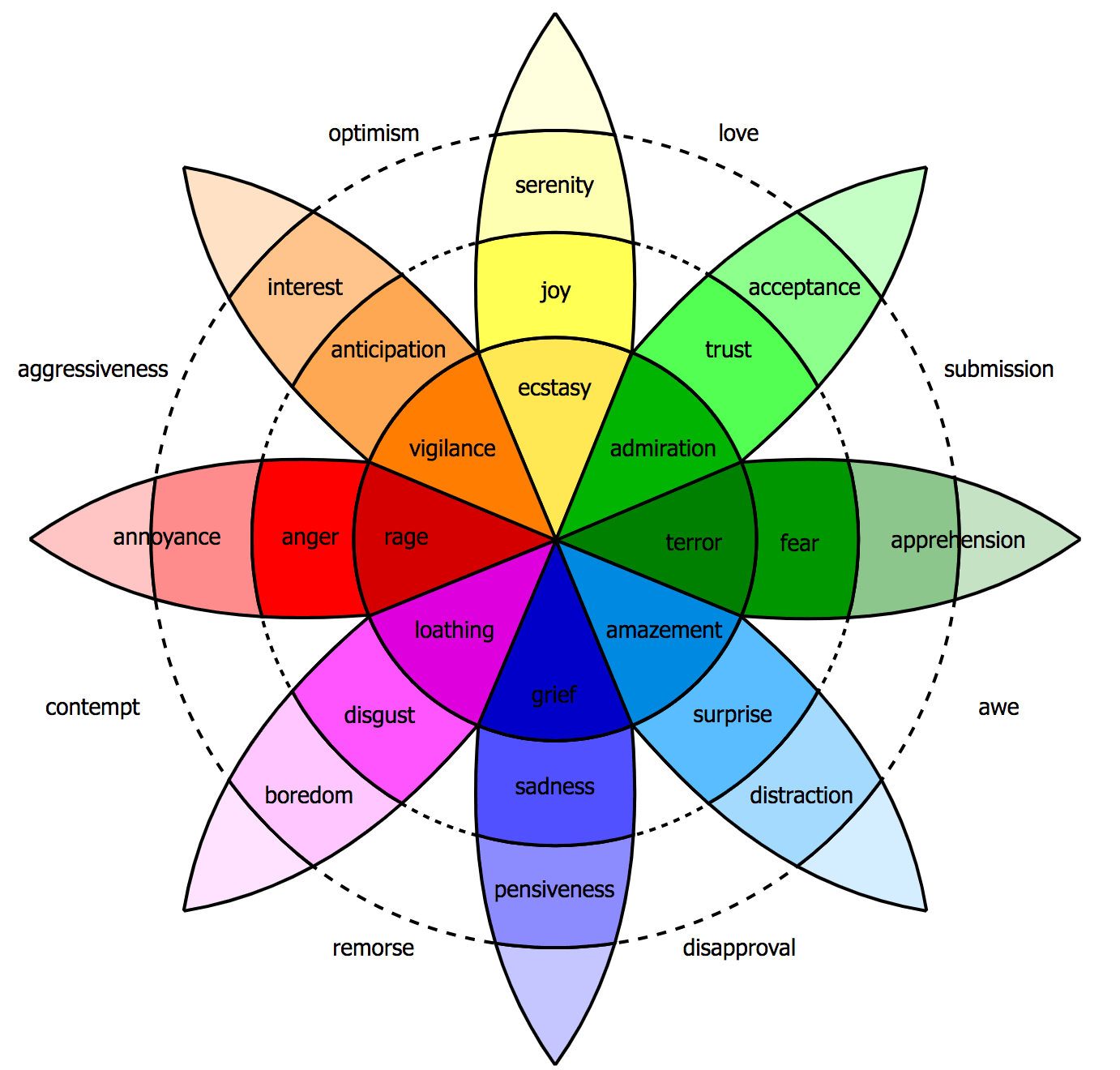
Real human emotional experience is layered. A character who is primarily threatening someone is also, somewhere underneath, secondarily hurt by them, or afraid of them, or genuinely amused by their own cleverness. A character who is primarily grieving is also, somewhere underneath, secondarily angry, or relieved, or guilty. The interplay between the primary emotion and the secondary emotions underneath it is what makes the performance feel like a person instead of a position.
When you're prepping a monologue, write down the primary emotion at the top of the page. Then write down two or three secondary emotions the character could plausibly be experiencing underneath. Then go through line by line and decide which lines pull more strongly toward the secondary colors. A primarily annoyed character can have a moment of fear. A primarily threatening character can have a moment of playfulness. A primarily heartbroken character can have a moment of bitter laughter.
Layer those into the monologue. Suddenly your sunset has more than one color in it.
Why Comedy Especially Demands Contrast
If you have any comedic instinct, lean into it for auditions. The pool of performers who can deliver convincing dramatic monologues is enormous. The pool who can deliver genuinely funny monologues — without leaning on the writing to do the work — is much smaller, and casting directors notice instantly.
But here is what I want you to understand about comedy specifically: comedy is built almost entirely on contrast.
Drama can sustain a single emotional register for a long time and still hold the room. Comedy cannot. Comedy lives in the gap between what the audience expects and what the character delivers. The classic visual gag — a glamorous, perfectly dressed figure striding confidently down the street and then face-planting into a mud puddle — works because of the contrast between dignity and indignity. Take away either side of that contrast and the joke evaporates. A perfectly-dressed person walking confidently isn't funny. A muddy person falling isn't funny. The contrast is the joke.
The same principle drives almost every laugh line in every comedic monologue ever written. A character who's been aggressive for three lines suddenly becomes pouty and small. A character who's been formal and composed suddenly cracks. A character delivering threats with a sneer suddenly slips into a delighted giggle at their own meanness. The shift is where the laugh lives.
If you stay in one tonal color throughout a comedic monologue, you will not get laughs even if every word is hilarious on the page. The casting director is reading the room you're creating, not the page. You have to build the contrast.
Some specific moves that almost always pay off:
For a villainous role where the character is being cruel — think roles like the eccentric headmistress in Matilda, the haughty antagonist in Chitty Chitty Bang Bang, the wicked stepmother types in Into the Woods or Cinderella — the standard delivery is to play everything big, loud, and aggressive. The casting team has seen that take a hundred times. The version that wins the room is the one that goes quiet and dangerous on the threats, then loud and ridiculous on the absurd self-pity, then suddenly small and almost vulnerable for a single line, then back to vicious. Same character. Same words. Completely different effect.
For a campy or heightened role — think the manic energy of characters from Rocky Horror Show, Little Shop of Horrors, Heathers, Mean Girls — the standard delivery is wall-to-wall manic energy. Resist that. The character is more interesting if the manic energy cuts against moments of stillness, conspiracy, or strange tenderness.
For a clueless or self-absorbed comedic role — think characters from Legally Blonde, Hairspray, Bring It On, Mean Girls — the standard delivery is bubbly throughout. Better: bubbly mostly, but with sudden moments of unexpected sharpness or genuine hurt. A character we initially read as one-dimensional and then discover has dimensions is a casting director's dream.
Diction: When the Accent Eats the Performance
A specific note for performers using heavy character accents — German baroness, Cockney urchin, Southern matriarch, Russian villain, anything where the dialect is part of the character.
The accent is not the performance. The accent is a flavor on top of the performance. If the audience can't understand what you're saying, every other choice you made dies inside the accent. Casting directors regularly cut otherwise excellent auditioners because the dialect made the words incomprehensible.
The fix is twofold. First, soften the accent slightly for the audition itself. Don't pull it back to neutral — you'd lose the character. But dial down whatever percentage you're hitting in your most committed practice version. If you're at 100% accent at home, try the audition at 70%. The character will read just as strongly, and the words will land.
Second, overemphasize the mouth movements when you're delivering accented text. Your lips, tongue, and jaw need to do more work, not less, when there's a dialect on top of the words. Big, deliberate, slightly slower articulation of consonants is what makes accented English understandable to a listener. Watch any great character actor doing dialect work and you'll see them sculpting every consonant with their mouth even at speed.
The single best daily practice for this is tongue twisters. Five minutes a day with a packet of tongue twisters — the classic red leather yellow leather, unique New York, toy boat toy boat toy boat type drills — over a few weeks will radically strengthen the small muscles of your articulators. When you then put a dialect on top of clean, well-articulated English, the words still come through. When you put a dialect on top of mushy articulation, nothing comes through.
The Triple-Threat Reality
One last thing, and this is uncomfortable but I have to say it because nobody else is telling you.
Musical theater auditions are not auditions for one skill. They are auditions for three skills, and you are being evaluated on all three regardless of which one feels like your primary discipline.
If you walk in as a strong actor with a workable voice and no dance training, you are losing roles to performers with two-out-of-three. If you walk in as a strong singer with limited acting and no dance, same problem. The triple-threat standard for the average MT audition has been climbing steadily for years, and the floor for what counts as "passable" in each of the three is now higher than most performers realize.
This is not a counsel of perfection. You don't need to be elite in all three. You need to be competent in all three and excellent in at least one. A great singer with passable dance and passable acting books work. A great singer with no dance and no acting does not.
What does this mean for your prep practically?
If acting is the weak leg of your triple threat, hire a coach for monologue work or at minimum drill it on your own with the kind of discipline I've described above. Monologue prep is not "memorize the words and run it a few times." Monologue prep is analyzing primary and secondary emotions, mapping contrast across pitch, pace, and projection, drilling diction, and rehearsing under pressure.
If singing is the weak leg, you need a voice teacher and you need to be doing technical work on your mixed voice, not just running songs. The mid-range belt-mix area is where most MT casting actually lives — not the showpiece high notes, but the working register where most of the score sits. If your mix isn't there, every other vocal strength you have is being delivered with an asterisk.
If dance is the weak leg, this is the cheapest one to fix. There are entire libraries of free dance classes on YouTube — beginner ballet, beginner jazz, musical theater dance fundamentals, basic tap. You don't need to pay for a studio to develop a working dance baseline. You need to put on the video three times a week and move. Pick up the vocabulary. Learn what a grapevine is and what a step ball change is. Be able to follow a basic combination in a callback.
The performers who win roles are not the ones who are world-class in one discipline. They're the ones who showed up genuinely prepared in all three.
Putting It All Together
So you've got an audition next month. Here's what your prep looks like.
You pick a monologue that suits your strongest performance instincts — comedic if you have comedic instincts, dramatic if you're stronger there. You read it through and identify the primary emotion. You list two or three secondary emotions the character could plausibly experience underneath. You go line by line and decide which lines pull more strongly toward each color.
You then go through again with the three P's. Where does the pitch want to drop? Where does it want to lift? Where does the pace want to slow? Where does it need to quicken? Where does the projection pull back to intimacy, and where does it open up? You mark all of this in your script.
You run the piece with those marks. The first few times you'll feel ridiculous — every choice will feel too big. Trust that. Keep running it. The choices will integrate.
You record yourself. You listen back. You're going to discover that what felt huge sounds appropriate, and what felt subtle sounds nonexistent. You push the contrast bigger.
You drill tongue twisters for ten minutes a day so your articulation is sharp.
You're also doing your daily vocal exercises — your lip bubbles, your mixed voice work, your runs through head voice and chest voice and the mix between them. You're booking time on YouTube with dance instructors a few times a week.
You walk into that audition with the kind of preparation most of the room hasn't done.
And you book.
Want to work with me one-on-one?
Looking for more?