Beyond the Cool Voice: How to Add Real Depth to Your Voice Acting
Here's the thing nobody tells you when you're starting out in voice acting: having a great character voice is not enough. It's not even close to enough.
I work with a lot of voice actors who come in with genuinely impressive vocal abilities. They can do the deep, menacing villain. They can do the quirky sidekick. They've got range in the traditional sense — they can access different character types. But when I listen to their auditions, I hear the same problem over and over: one emotional note sustained across an entire read. The voice sounds cool, but it doesn't sound alive.
If you want to book voice acting work — especially in animation, gaming, and narrative projects — you need to move past the surface-level character voice and start thinking about emotional complexity. Here's how I approach that with the actors I coach.
Want to work with me one-on-one?
The Three P's: Your Foundation for Vocal Variety
Before we get into the deeper emotional work, let's establish a simple framework that should be running in the background of every line you deliver. I call it the three P's: pitch, pace, and projection.
Pitch is where your voice sits — high or low. Pace is how quickly or slowly you deliver the line. Projection is your volume and intensity — loud or soft, forceful or restrained.
Most beginning voice actors default to a narrow range across all three. They find the pitch that "feels right" for the character and stay there. They lock into a pace — usually too fast — and maintain it throughout. They pick a volume level and ride it from the first line to the last.
The fix is simple in concept and challenging in practice: vary all three, constantly, within a single read. A powerful villain character might generally sit in a lower pitch, slower pace, and softer volume — yes, softer, not louder. We'll come back to that. But within that general range, every line should shift at least one of those variables. A line of contempt might drop the pitch further and slow the pace. A line of barely contained anger might push the projection up while the pace tightens. A moment of dark amusement might lift the pitch slightly and quicken the rhythm.
When all three P's are moving, the performance breathes. When they're static, even the best character voice starts to feel monotone.
Strength Without Volume: The Mistake Almost Everyone Makes
This is one of the most important lessons in voice acting, and it's counterintuitive: powerful characters are often most powerful when they're quiet.
Think about the most intimidating people you've ever encountered — real or fictional. The truly dangerous ones don't yell. They don't need to. Their authority comes from control, from the sense that they could explode at any moment but are choosing not to. That restraint is what creates tension.
Beginning voice actors almost always equate intensity with volume. When a line calls for menace, they get louder. When a character is angry, they shout. When a scene climaxes, they push everything to maximum.
But in voice acting — where a microphone is inches from your mouth and every nuance is captured — volume is the least interesting way to convey power. A whispered threat is more chilling than a shouted one. A calm, measured statement of dominance lands harder than a raging declaration. The controlled delivery tells the listener that this character is so confident, so assured of their superiority, that they don't even need to raise their voice.
Practice this: take a line that feels like it should be loud and angry, and deliver it at half the volume you instinctively want to use. Slow it down. Let pauses do the heavy lifting. You'll be surprised at how much more dangerous it sounds.
Emotional Color: Moving Past One-Note Characters
Here's where the work gets really interesting. I use an approach based on Plutchik's wheel of emotions — a psychological model that maps out primary emotions and how they blend together, almost like mixing paint colors. You don't need to memorize the whole wheel, but the concept behind it will transform how you approach character work.
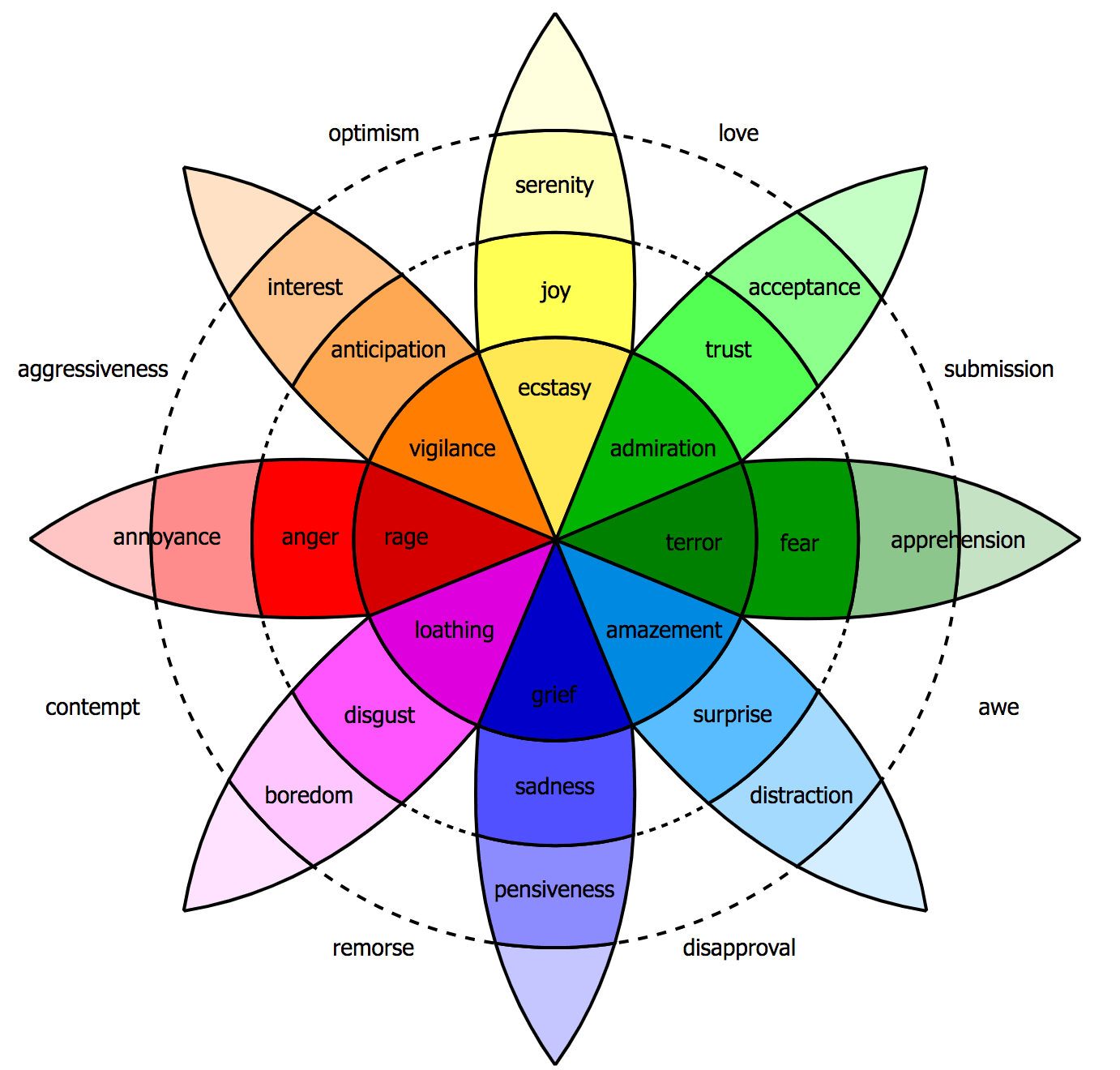
The idea is this: no real person — and no well-written character — operates on a single emotion. A villain isn't just angry. Underneath the anger, there might be contempt, or disgust, or even a twisted form of admiration for their adversary. A grieving character isn't just sad. There's fear in grief, and sometimes relief, and almost always some shade of anger. Emotions layer and blend, and the most compelling voice performances reflect that complexity.
When you're preparing a monologue or audition piece, go through it line by line and identify the dominant emotion. Then — and this is the crucial step — identify the secondary emotion underneath it. What else is the character feeling that they might not even be aware of? That secondary emotion is where the interesting performance lives. It's the color that makes the character feel three-dimensional instead of flat.
For example, a character delivering a monologue of contempt for their enemy might have a dominant tone of cold disdain. But underneath that, maybe there's a flicker of respect — they wouldn't bother with this speech if they didn't consider their enemy worthy of the attention. Letting that secondary color peek through, even briefly, transforms the read from a generic villain monologue into something specific and human.
Try this exercise: pick a monologue and identify three or four different emotional colors within it. Then practice delivering it with each of those colors as the dominant tone for different sections. Don't signal the transitions — let them happen organically, the way real emotions shift. The goal isn't to perform a checklist of emotions. It's to create the impression that this character has a rich inner life happening beneath the words.
Pacing and Status: What Your Speed Says About Your Character
How fast a character speaks tells the audience something fundamental about who that character is, and most voice actors default to speaking too quickly.
Speed communicates status. High-status characters — kings, CEOs, master villains, ancient beings — tend to speak slowly and deliberately. They pause. They let silence work for them. They're in no rush because they don't need to be. The world waits for them, not the other way around.
Lower-status characters, nervous characters, characters who are trying to prove something — they talk fast. They fill silence because silence feels dangerous. They rush through their lines because on some level, they're afraid of being interrupted or dismissed.
This is a tool you can use intentionally. If you're voicing a character who commands authority, slow down more than feels natural. Add pauses where the script doesn't indicate them — between clauses, before key words, after statements that the character wants to land. Let the silence communicate confidence.
A common note I give actors: the pause before a word is often more powerful than the word itself. If a character says "You are nothing to me," the pause before "nothing" does more work than any vocal inflection on the word. The pause creates anticipation. The audience leans in. Then the word arrives and it hits harder because they were made to wait for it.
The Voice Acting Audition Is Not a Theater Audition
If you're coming to voice acting from a theater background — and many voice actors do — there's a critical adjustment you need to make, and it's about time.
In theater, auditions often give you room to build. You might have a full monologue to establish your character, find your rhythm, and develop an arc. In film, you typically get a scene or two. In voice acting, you might get three lines. Sometimes fewer.
That means your character needs to be fully present from the first syllable. There is no warm-up period. There is no slow build. The casting director is listening to dozens, sometimes hundreds of auditions, and if you don't grab them immediately, they've already moved on before your second line.
This has practical implications for how you practice. Take the first line of any piece you're working on and practice delivering it at full character intensity, cold, with no lead-in. Record yourself and listen back: does the character exist in that very first moment? Or does it take you a line or two to find the voice? If it's the latter, you need to practice entering the character faster.
A useful drill: record three takes of just the first line of a piece, each one escalating in commitment and specificity. The first take is your instinct. The second take pushes the character choice further. The third take goes even further than you think is appropriate. Listen to all three. Surprisingly often, the third take — the one that felt like "too much" — is actually the most compelling.
The Four Registers: Your Technical Foundation
On the technical side, understanding your four core vocal registers gives you a much wider palette to work with for character creation.
Chest voice is your natural speaking register — full, grounded, resonant. This is where most male characters and many authority figures live. Head voice is your upper register — lighter, breathier, sometimes ethereal. Between these two are the mixed voices: chest-dominant mix, which adds brightness and forward placement to your chest voice, and head-dominant mix, which brings a lighter, more youthful quality while still maintaining clarity and projection.
Each register suggests different character types and emotional states. A character speaking in pure chest voice sounds grounded and authoritative. Shift into chest-dominant mix and you get something brighter, more energized, maybe more confrontational. Head-dominant mix creates characters that are younger, more innocent, or more emotionally vulnerable. Pure head voice can be ethereal, otherworldly, or comedic depending on how you use it.
The real skill is transitioning between registers within a performance — letting a character's vocal placement shift as their emotional state shifts. A confident character who gets caught off guard might involuntarily slide from chest into a higher mix. A timid character finding their courage might gradually drop into a fuller chest voice. These register shifts, when they happen organically, create the impression of a character who's actually experiencing something rather than just reading lines.
Practice moving through all four registers cleanly, without cracks or breaks. This is daily work — it doesn't take long, but consistency matters. The goal is to make every register available to you at any moment, so you can make choices in real time rather than being limited to whichever register feels safest.
One Hundred Auditions Before You Judge Yourself
I'll close with a piece of career advice that doubles as creative advice: you need volume before you need perfection.
If you're just starting out in voice acting, set yourself a goal of one hundred auditions before you seriously evaluate where you stand. Use free platforms. Audition for projects that excite you and projects that don't. Try characters that fit your natural voice and characters that stretch you completely out of your comfort zone.
The purpose isn't to book those first hundred auditions — though you might surprise yourself. The purpose is to build the reps that turn all of this theory into instinct. Emotional color analysis, the three P's, pacing and status, register shifts — these concepts are useful to understand intellectually, but they only become part of your performance when you've practiced them under real conditions, with real stakes, over and over again.
Every audition teaches you something. Every one. Even the terrible ones — especially the terrible ones. So stop waiting until you feel ready, and start accumulating experience. The voice acting career you want is on the other side of a lot of imperfect auditions, and that's exactly how it's supposed to work.
Want to work with me one-on-one?
Looking for more?